RESOURCES
Your Shortcut to Smarter Data
We’ve got the tips, tricks, tools, and insights to make your next data project a breeze. Check out our resources below.


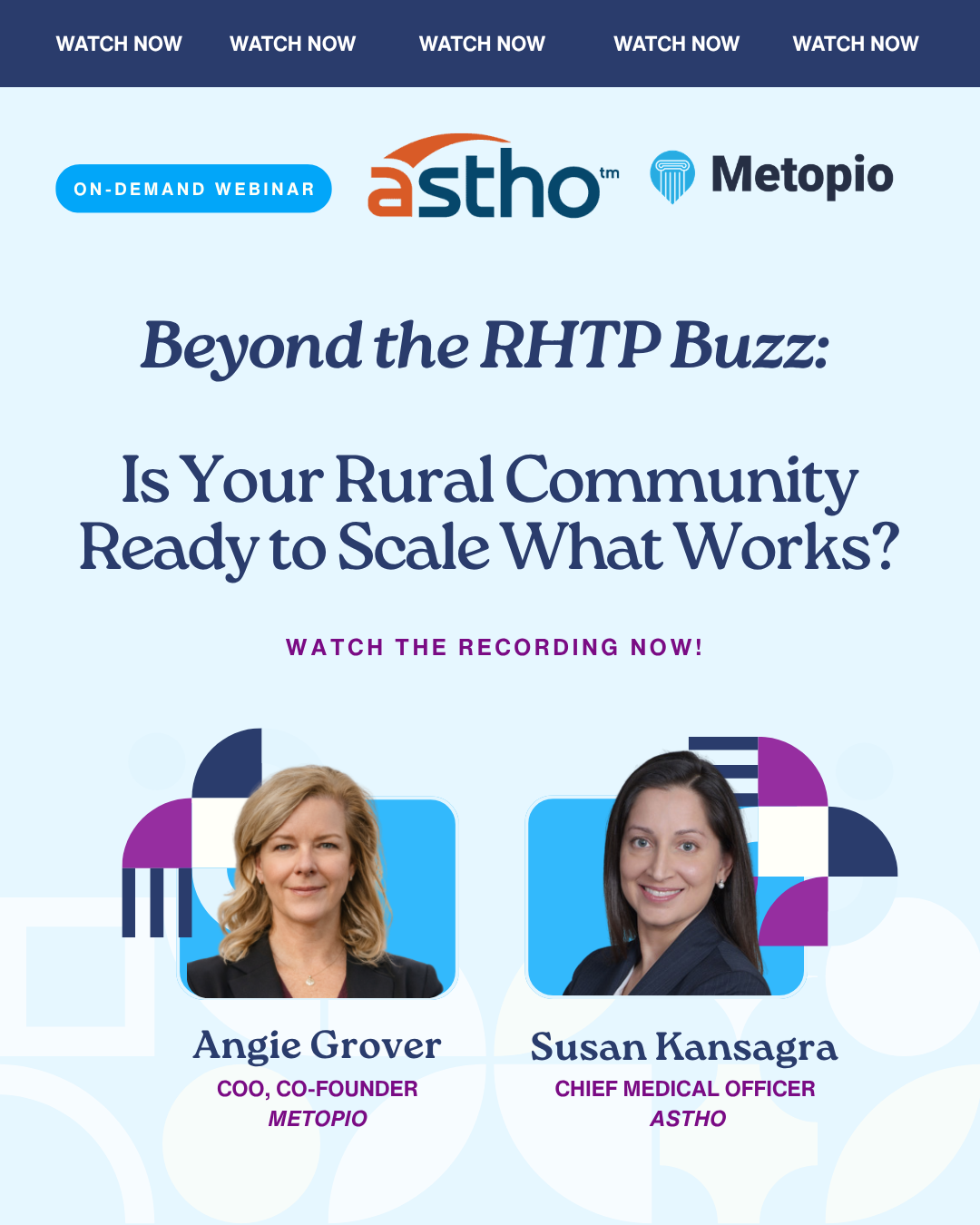
WATCH THE REPLAY NOW!
Beyond the RHTP Buzz: Is Your Rural Community Ready to Scale What Works?
The Rural Health Transformation Program represents an unprecedented investment in rural health, but the opportunity is bigger than funding. It’s a chance to understand what rural communities need, identify what’s already working, and build the case for what should grow.
In this replay, ASTHO and Metopio have a practical conversation about how organizations and communities can use granular data, connect it to local assets & outcomes, and position programs for investment & expansion.
Whether you're a hospital, health department or community organization, watch to explore how to use the RHTP moment to make a stronger case for your community and build solutions that last beyond the funding.
-
![Blue presentation slide titled 'How Collaboration and Shared Data Can Improve Health Outcomes' with a purple and white geometric logo in the bottom right corner.]()
How Collaboration and Shared Data Can Improve Health Outcomes
-
![moving to mapp 2.0 webinar metopio]()
Moving to MAPP 2.0 to Maximize Your Impact
-
![Rethinking Surveys: Smarter Data Collection for Deeper Community Engagement]()
Rethinking Surveys: Smarter Data Collection for Deeper Community Engagement
-
![the future of chnas webinar]()
The Future of CHNAs: Technology, Time-Saving Tips, and Real Results
-
![5 minute product overview from metopio]()
Metopio 5-Minute Product Overview
-
![role of public health supporting healthy aging webinar]()
Growing Old Together: The Role of Public Health in Supporting Healthy Aging
-
![accelerate chip strategies webinar]()
How to Accelerate Your CHIP Strategies
-
![maternal health metrics webinar]()
Metrics that Matter for Maternal Health
-
![Webinar announcement titled 'How 20+ Organizations Are Collaborating to Transform Community Health in Central North Carolina' by METOPIO with a hexagon pattern logo.]()
How 20+ Organizations Are Collaborating to Transform Community Health
-
![Slide from a webinar presentation titled "Leveraging Community Context to Revolutionize Rural Healthcare." The slide has a blue background with the title in large, bold text, and includes design elements like a small dark blue rectangle with white text, and a graphic consisting of three overlapping circles in pink, dark purple, and light purple inside a blue square.]()
Leveraging Community Context to Revolutionize Rural Healthcare
-
![Webinar banner for 'Going Beyond Community Benefit to Drive Broader Community Impact with Your Next CHIP' with a purple flower icon.]()
Going Beyond Community Benefit to Drive Broader Community Impact with Your Next CHIP
-
![Slide from a webinar titled 'The State of Community Health Data' with a decorative logo in the bottom right corner.]()
The State of Community Health Data
-
![Slide from a webinar titled 'Taking Advantage of Data Partnership Opportunities to Reshape CHAs and CHIPs' with a geometric logo in the bottom right corner.]()
Taking Advantage of Data Partnership Opportunities to Reshape CHAs and CHIPs
-
![Webinar presentation slide with title 'What AI Can (and Can't) Do for Public Health' and logo of NACCHO, the National Association of County & City Health Officials.]()
What AI Can (and Can't) Do for Public Health
-
![A digital banner displaying the title 'AI Policies That Work: Practical Guidance for Public Health' with a subtitle 'METOPIO WEBINAR' at the top, a light blue background, and a graphic of a purple and pink virus icon on the right side.]()
AI Policies That Work: Practical Guidance for Public Health
-
![Webinar banner for Metopio titled 'Navigating the ACS Data Release Without Losing Momentum' with a 'Watch the Webinar Replay' button in purple.]()
Navigating the ACS Data Release Without Losing Momentum





Customer Success Stories
Hear from our happy partners and how they’re transforming data into action



Metopio Blog
Explore our blog for smart takes, fresh insights, and the latest trends.